
Most store owners start by picking a colour or sketching a layout, but the first thing that actually matters is how much weight each shelf can carry. Choose a load rating that’s too low for your stock and you’ll get bent, sagging shelves within months — and a full frame replacement, not just a new panel. Here’s how to match the right strength to your products from day one.
Why “load per shelf” should be your first filter
Load rating per shelf is the spec that decides whether your shelving lasts. Even products that feel light add up once a shelf is fully packed, and an under-rated shelf will warp and bow within months. Swapping to a stronger model later means tearing out the whole frame rather than replacing a single panel, so the cost of guessing wrong is far higher than specifying correctly the first time.
Light-duty shelving (~60 kg per shelf)
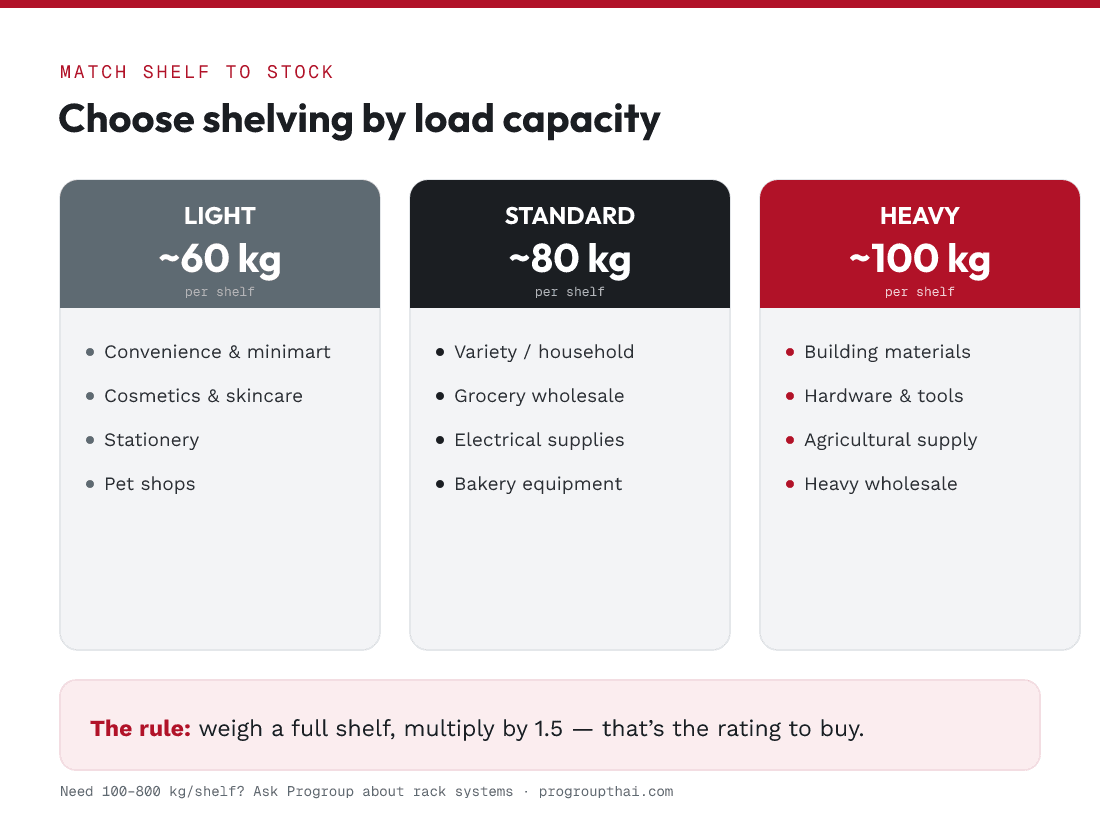
The entry tier, built for merchandise that isn’t heavy but needs to look tidy and well presented. It suits convenience stores and minimarts (snacks, sachets, packaged goods), cosmetics and skincare shops, stationery and office-supply stores, and pet shops with small bags of food and accessories. If your stock is small-format and fast-moving, this gives clean presentation without paying for strength you won’t use.
Standard-duty shelving (~80 kg per shelf)
About 33% more capacity than light-duty, and the right call for stores with mid-weight goods: household and variety stores (soap, shampoo, cleaning liquids), grocery wholesalers handling bottles and cans, electrical-supply shops with lamps and cabling, and bakery-equipment retailers. It’s the safe default when products are heavier than packaged snacks but not yet bulky building materials.
Heavy-duty shelving (~100 kg per shelf)
The strongest of the three core tiers, engineered for large or dense products: building-material outlets (cement, sand, tiles, PVC pipe), hardware stores with power tools, agricultural-supply shops with sprayers and equipment, and wholesalers moving heavy stock such as oil and bulk volumes. When a fully loaded shelf approaches three figures in kilograms, this is the tier that holds its shape.
The full comparison
| Tier | Load per shelf | Typical use | Best-for store types |
|---|---|---|---|
| Light-duty | ~60 kg | Light, display-led products | Convenience, cosmetics, stationery, pet shops |
| Standard-duty | ~80 kg (+33%) | Mid-weight everyday goods | Variety/household, grocery wholesale, electrical, bakery |
| Heavy-duty | ~100 kg (+67%) | Heavy, bulky, high-volume goods | Building materials, hardware, agricultural, heavy wholesale |
| Medium-heavy rack | 100–200 kg | Large drums, big tools | Parts depots, mid-size warehouses |
| Warehouse stock rack | 200–800 kg | Pallets, crates, heavy parts | Warehouses, bulk wholesale |
How to choose: a quick decision process
- How much does one unit of your main product weigh?
- Multiply by the number of units that fit on a full shelf — that’s total weight per shelf.
- Multiply that total by 1.5 for a safety margin — that’s your minimum required rating.
- Match the result to the tier table above.
Because Progroup builds to order, every tier can be customised on size, colour and back-panel type, so you don’t need to over-spec just to unlock a feature.
Frequently asked questions
What’s the difference between the three shelving tiers?
They differ mainly by load rating per shelf: light-duty holds about 60 kg, standard-duty about 80 kg, and heavy-duty about 100 kg. Pick the tier that matches your real fully-stocked shelf weight multiplied by roughly 1.5 for safety. The structure and uprights get progressively sturdier as the rating increases.
What happens if I choose a load rating that’s too low?
An under-rated shelf will start to bow and warp within about 6–12 months of carrying more than it was designed for. Fixing it usually means replacing the entire frame, not just the bent panel, so the long-term cost ends up higher than buying the correct tier at the start. Specifying with a 1.5× safety margin avoids this.
What if my products are heavier than 100 kg per shelf?
Move up to a rack system. A medium-heavy rack handles roughly 100–200 kg per shelf for large, dense items, while a warehouse stock rack carries 200–800 kg per shelf for pallets and heavy parts. Progroup can build either to match your load and space.
Can I still customise colour and finish on heavier tiers?
Yes. Because Progroup manufactures to order, customisation such as size, colour and back-panel type is available across all tiers, so you never have to over-spec the load rating just to access a particular option. Choose the strength your stock needs, then tailor the look separately.
Planning your store? Let’s build the shelving to fit.
Progroup designs, manufactures and installs custom shelving, racking and counters — any size, any colour, made in Thailand, with a free 3D layout for your space.